


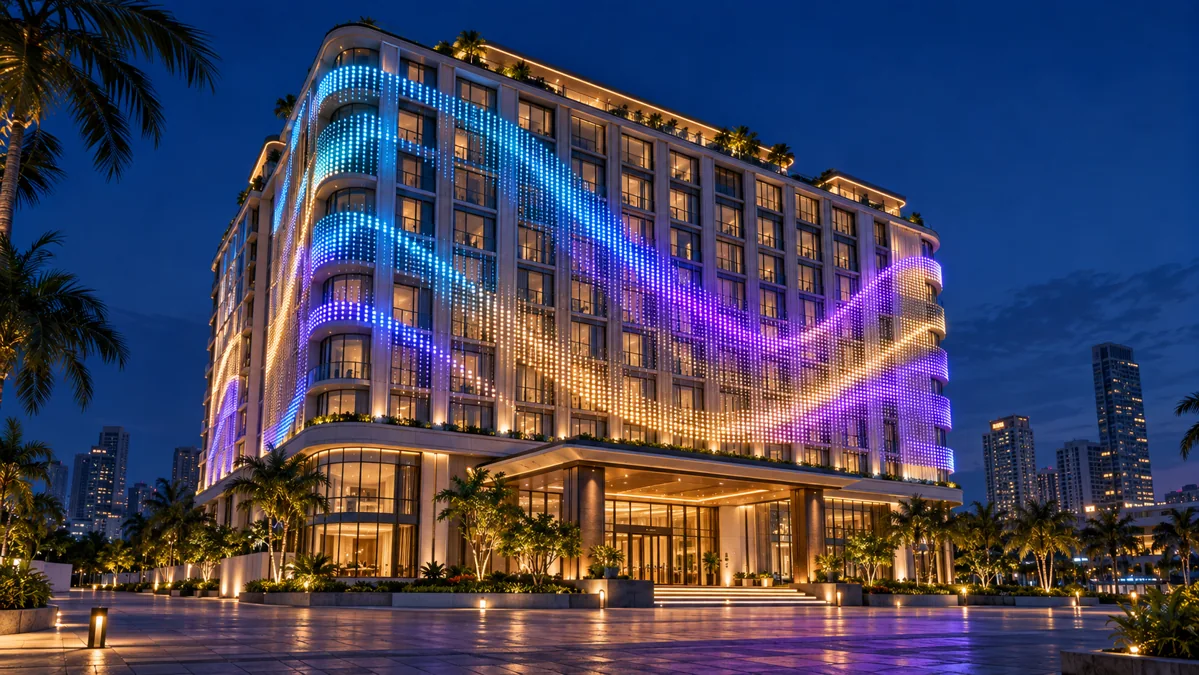
LED pixel lights let every point of light be controlled individually, turning the whole facade into a low-resolution screen. This is the highest level of investment in architectural lighting, so choosing the wrong equipment is very costly. Chinese manufacturers, with many of the world’s largest media facades, have optimised pixel lights in the five directions below.
1. Smooth dimming without steps
At low brightness, fixtures with only 256 levels (8-bit) move between light and dark in visible steps. Fixtures with 65,536 levels (16-bit) give smooth transitions, especially for fades and slow night-time effects. For media facades, prefer control chips that support 16-bit.
2. No flicker on camera
A beautiful facade will be photographed and filmed by visitors and the press. Fixtures with a low refresh rate show stripes and flicker on phones. The simplest test: film a sample running at low brightness in slow motion on a phone before you commit.
3. One failed point does not black out the rest
With standard series data transmission, the signal passes through each pixel before reaching the next. If one pixel fails, every pixel after it can go dark. Many current pixel products have a backup signal path that lets data bypass the failed point so the rest keeps running. On hard-to-reach high-rise facades, this feature should be mandatory.
4. Colour consistency between batches
Thousands of pixels must produce the same white and the same hue. Ask suppliers to use LEDs from the same colour bin, to apply colour calibration, and to keep spare fixtures from the same batch for warranty replacements, so new fixtures do not stand out.
5. Pixel pitch to suit viewing distance
A facade seen from far away does not need the density of a screen. Pixel spacing should follow viewing distance and the content you want to show: text and logos need higher density than colour and motion effects. Simulating first on a 3D model helps choose the right density and avoid waste.
Power and control for pixel systems
- Central power at a higher voltage: less voltage drop on long runs, see 48 V LED.
- Network control: large pixel systems usually stream content from a master controller over Ethernet or fibre to sub-controllers, which then convert it into the signal for the fixtures. See large-scale lighting control architecture.
- Monitoring: status feedback helps find failed points early, see RDM fault monitoring.
Frequently asked questions
How do pixel lights differ from an LED screen?
An LED screen has very dense pixels to show sharp images. Pixel lights on a facade are spaced further apart, are lighter and leave the architecture visible, making them better suited to lighting effects than advertising.
Is a permit needed for a media facade?
Work with the local urban authority first, especially when showing content or logos.
See the Facade Signature indicative budget. Send a photo of your facade via Zalo +84 935 004 188 to see a pixel simulation of your building.
