


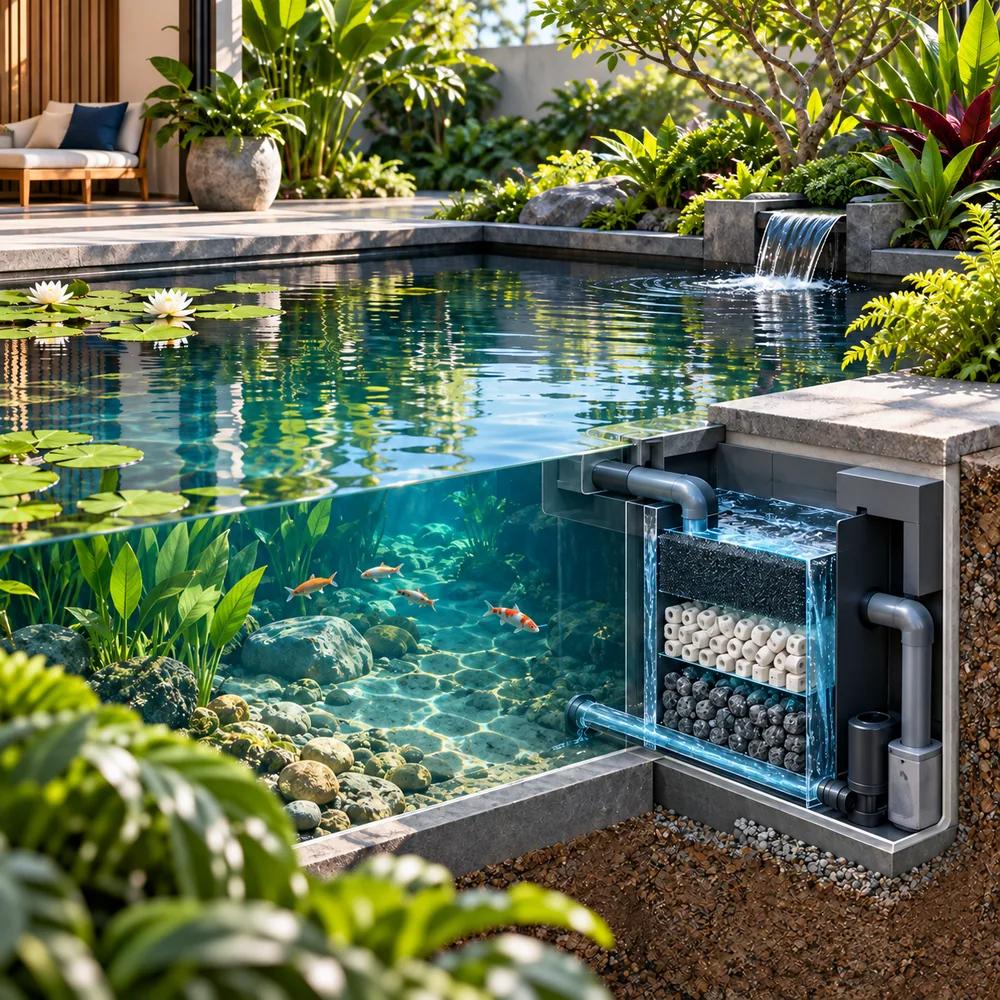
Clear water is what keeps a landscape pond or fountain looking good. For a musical fountain, filtration matters even more: nozzles have small orifices, and a little debris is enough to bend or weaken a jet and spoil the whole show. This article explains the common filter types and how to choose between them.
Why landscape water needs its own filtration
- Leaves, dust and sand blow into the pool, settle on the bottom and get drawn into the pump.
- Algae grows quickly when water sits in the sun.
- Debris blocks nozzles and wears pumps, shortening equipment life.
Common filter types
Screen filters (coarse filtration)
A stainless steel or plastic screen catches litter and large particles. Simple and inexpensive, they are usually fitted before the pump to protect it. The drawback is frequent manual cleaning if the pool collects a lot of debris.
Disc filters
A stack of grooved discs traps dirt as water passes through the grooves. Disc filters hold more dirt than a screen filter of the same size and are easy to backwash, which makes them a popular choice for irrigation and fountains. See the AZUD filter range, for example the AZUD Modular 300.
Automatic and semi-automatic filters
These clean themselves based on pressure difference or a timer, so they rarely need to be opened. They suit large pools, musical fountains that run every day, or sites where no one is available to clean filters. See the Amiad filter range, such as the Scanaway and Brushaway.
Sand filters
Water passes through a bed of sand or filter media that traps very fine particles for clearer water. Common in swimming pools, sand filters are bulkier and need space.
How to choose the right filter
- Flow rate: the filter must handle the flow of the filtration pump. An undersized filter clogs quickly and loses pressure.
- Filtration grade: match it to the smallest nozzle orifice in the system. The smaller the nozzle, the finer the filtration.
- Debris load: pools under trees, near roads or construction sites need a filter that holds a lot of dirt or cleans itself.
- Cleaning effort: if no one checks the system regularly, choose an automatic filter.
- Location: install it in the pump room or technical pit with enough space to open and service it.
Filtration in a musical fountain system
Musical fountains usually have two separate circuits: a show circuit feeding the nozzles and a recirculating filtration circuit that cleans the pool. Keeping them separate lets filtration run when there is no show and avoids reducing nozzle pressure. See what makes up a musical fountain.
Frequently asked questions
How often should the filter be cleaned?
It depends on the debris load and filter type. Screen and disc filters usually need a weekly check. Automatic filters only need periodic checks according to the manufacturer’s instructions.
Are chemicals needed?
Filters trap particles but do not kill algae. Many pools also need water treatment, depending on water quality and sun exposure.
Need help choosing a filter for your pond or fountain? Send the pool size, nozzle types and site photos via Zalo +84 935 004 188 and ARTTEC will recommend a suitable setup.
