


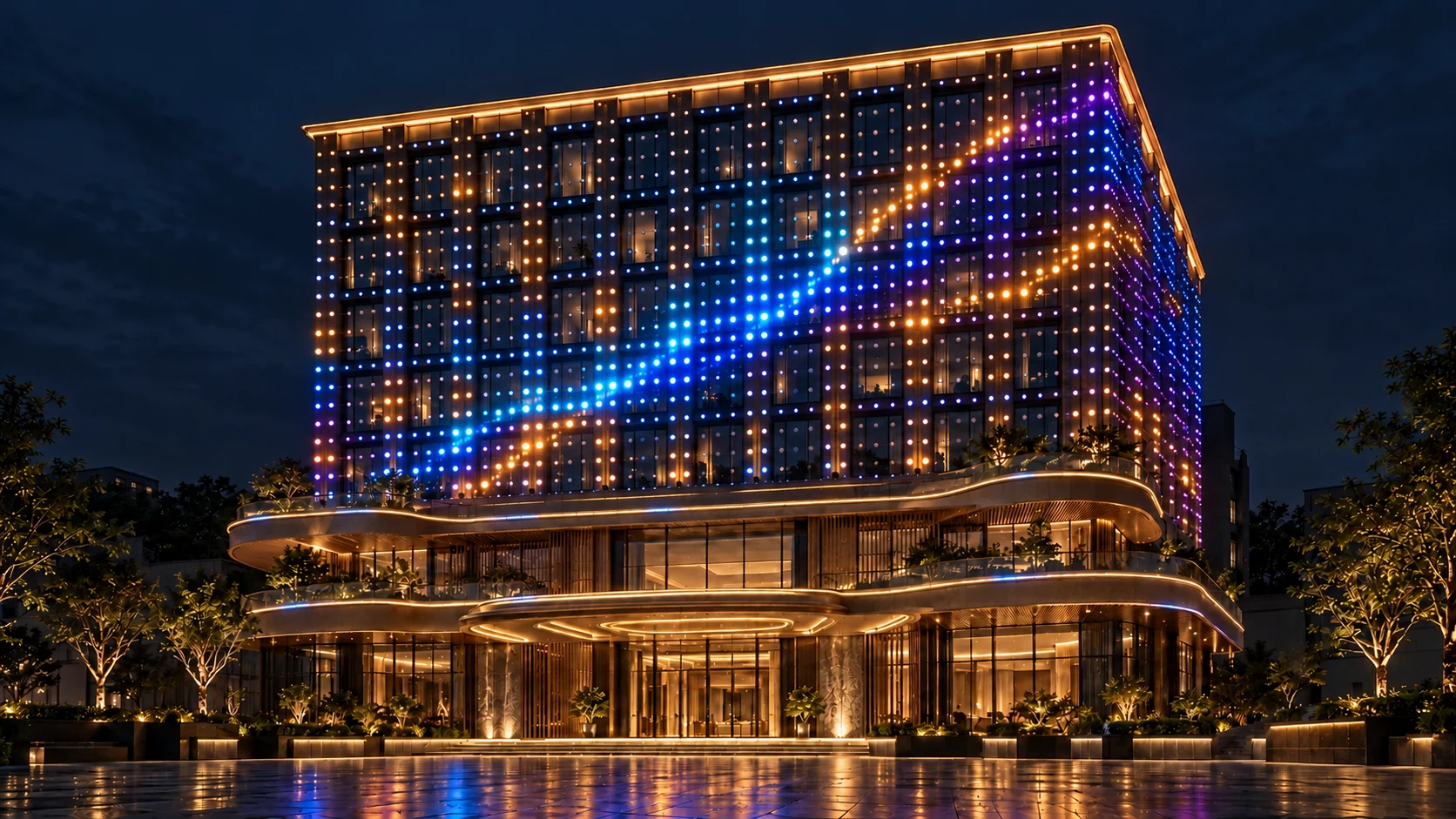
You own a hotel, office building or showroom in Da Nang, Hoi An, Hue or Quy Nhon and want the facade to look good at night. Four questions usually come up: which LED fixtures to use, whether they will survive near the sea, what it costs, and who fixes them when they fail. This article answers each one, based on ARTTEC’s installation experience in Central Vietnam.
Which LED fixtures should a facade use?
A good facade usually combines a few fixture types, each with its own job:
- Outdoor aluminium LED bars: run along ledges, balcony edges and window frames to draw the outline of the building. This is the most common choice for building decoration.
- Wall washers: spread light over a whole wall, column or stone surface to add depth.
- LED floodlights: light up roofs, towers, logos or large trees in front of the lobby.
- Waterproof outdoor LED strip: for curves and soft details that rigid bars cannot follow.
- LED pixel points: individually controlled points that can show text, images and effects, for buildings that want a strong landmark.
You do not need all five. ARTTEC selects fixtures based on the actual architecture so the facade stands out while keeping costs sensible.
Warm white or RGB colour changing?
This decision affects cost and image more than any other:
| Option | Effect | Suits |
|---|---|---|
| Static warm white | Elegant, highlights the architecture, the most durable and affordable | Hotels, offices, buildings in Hue and Hoi An |
| RGB colour changing with scenes | Warm white on normal nights, colours for holidays, slow effects | Beachfront hotels, buildings on main roads |
| Pixel points with images and text | The facade becomes a light screen and draws strong attention | Landmark buildings, shopping centres |
For hotels, the option most owners prefer is colour-changing fixtures that run warm white on normal nights. The facade stays elegant, and for Tet, the Da Nang fireworks festival or private events there is colour for photos and promotion.
Near the sea, which outdoor LED fixtures last?
Fixtures on facades along the Han River, My Khe beach or in Quy Nhon fail much faster than inland because of salt air, humidity and storms. When you review a quotation, ask about five points:
- Water protection: facade fixtures should be IP66 or higher; in-ground fixtures or those near water need IP67 or IP68. IP65 only handles light water jets. See IP65, IP66, IP67 and IP68 explained.
- Housing: aluminium with a marine-grade coating, not standard painted aluminium or galvanised steel.
- Screws and brackets: 316 stainless steel. 201 stainless is cheaper but rusts within months near the sea.
- Cable connectors: factory-moulded waterproof connectors. Water entering a connector is the number one reason a whole run goes dark.
- Power supplies: in a technical cabinet, not hung on the wall in rain and sun. 48 V supply reduces voltage drop on long runs. See why use 48 V LED.
In Hue, buildings are not right on the coast, but heavy rain and high humidity mean almost the same waterproofing requirements apply.
Do you need a technician to change colours for Tet?
No. ARTTEC installs remote LED controllers over 4G, so:
- The lights switch on at dusk and dim after midnight automatically.
- To change colours for Tet, national holidays or a hotel event, you simply send a request and our team updates it remotely.
- When a fixture fails, the system reports it so it can be fixed early.
You do not need to know what DMX or control software is. See 4G lighting controllers.
What does LED facade lighting cost?
There is no single price for every building, because cost depends on:
- Facade area and height, metres of LED bar, number of wall washers.
- Warm white or colour changing, with or without images and text.
- How marine-resistant the fixtures and accessories are.
- Working at height: scaffolding, lifts or rope access.
- A new building under construction or a finished building that needs rewiring.
See indicative budgets in facade lighting cost and budget. ARTTEC’s advice: do not compare fixture prices alone. Add replacement, electricity and maintenance over five years, because cheap fixtures near the sea often need replacing several times, each time with lift hire.
ARTTEC installation process
- Site survey: by day and night, measuring and locating cable routes and the control cabinet.
- 3D simulation: you see how the building will look at night and adjust colour and brightness until you are happy.
- Final design and detailed quotation: design, estimate and contract only after the 3D is approved.
- Installation and aiming: fitting, night testing, adjusting each fixture.
- Handover: operating guide, equipment records and spare parts from the same batch.
The person who surveys your site stays with the project until handover, so you have one point of contact.
Why choose a lighting company based in Da Nang?
Installation takes weeks; operation lasts years. A distant contractor may install well, but every repair or scene change means waiting and paying for travel. ARTTEC is based in Da Nang, reaches Hoi An, Hue, Quy Nhon and Lang Co quickly, and keeps spare parts for each project. For repairs, see LED facade lighting repair.
Frequently asked questions
How long do outdoor LED fixtures last?
Good LED chips last a very long time, but on coastal buildings fixtures usually fail because of power supplies, connectors and corroded housings rather than the chips. Choosing marine-grade accessories and regular maintenance keeps the system running for many years.
Is the electricity bill high?
For example, a facade with 100 fixtures of 18 W running 6 hours a night uses about 324 kWh a month. Dimming after midnight reduces this further.
An existing building has many failed lights. Does it need a full replacement?
Usually not. Many systems only need new power supplies, connectors and controllers. See facade lighting retrofit.
Send a photo of your facade via Zalo +84 935 004 188. ARTTEC will suggest suitable fixtures and arrange a site survey in Da Nang, Hoi An, Hue or Quy Nhon.

One thought on “LED Facade Lighting Installation in Da Nang, Hoi An, Hue and Quy Nhon”