


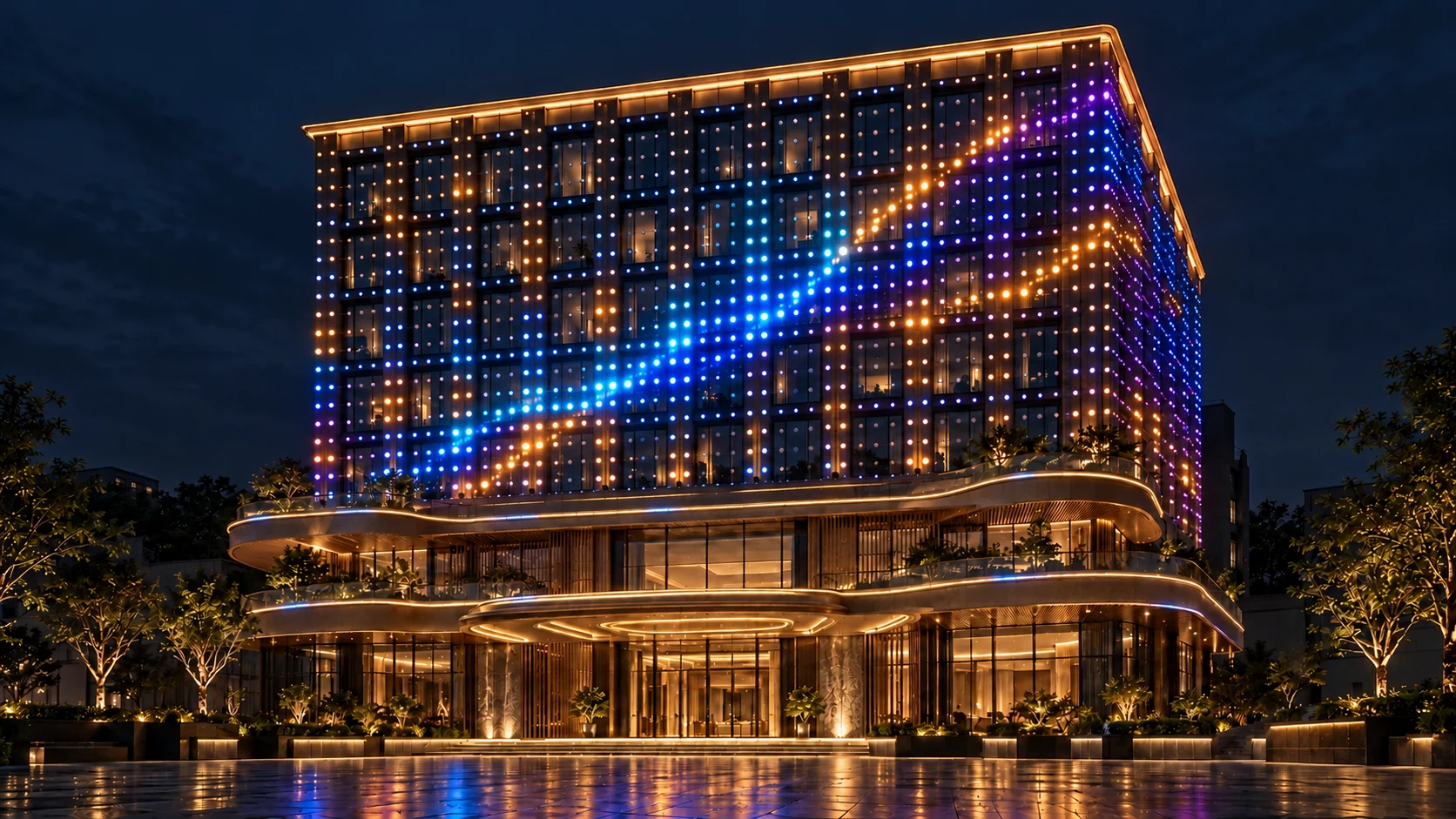
When lighting covers not one building but a whole street, bridge or urban area, the control system becomes decisive. Large landscape lighting projects in China have settled on a fairly consistent control architecture, which ARTTEC applies at the right scale for projects in Vietnam.
The four layers of a modern control system
- Management layer: software or a cloud platform to schedule, change scenes, view status and receive alerts from a computer or phone.
- Master controller at each site: stores shows, runs schedules and stays connected to the management layer.
- Sub-controllers: receive data over Ethernet or fibre and sit close to fixture groups to shorten signal runs.
- Decoders and fixtures: convert data into DMX512 or pixel signals for each fixture.
“Three-in-one” controllers
A notable trend among Chinese manufacturers is controllers that combine three capabilities:
- Standalone playback from an SD card: shows are stored in the device, so the lights keep running if the network drops.
- 4G or 5G connectivity: remote management and content updates without network cabling. See 4G controllers.
- GPS time synchronisation: sites far apart still run effects at the same moment. Some manufacturers state a synchronisation offset of only a few tens of milliseconds.
Synchronising multiple sites
For buildings along a riverbank or both ends of a bridge to change colour at the same moment, every controller needs the same reference clock. Combining several time sources, such as GPS and network time servers, keeps the system in sync even if one source is lost. This replaces long fibre runs between sites.
Status feedback and fault reporting
DMX512 only transmits one way. To know which fixture has failed, the system needs a feedback channel such as RDM. Some bridge projects in China with tens of thousands of wall washers use real-time feedback to monitor every device. At the scale of projects in Vietnam, a similar solution greatly reduces the cost of routine inspections. See RDM fault monitoring.
Networking scattered lighting points
For landscape lights, tree uplights and path lights scattered across a site, running signal cable to every point is expensive. Some systems use low-power long-range wireless for the small nodes, combined with 4G at the central controller to send data back to the management platform.
Energy management and security
- Energy: switch on and off with sunset times, dim after midnight and track consumption by zone.
- Security: keep the control network separate from the internal network, set user roles, change default passwords and keep software updated.
Choosing the right scale
A single hotel only needs a master controller with 4G and schedules. An urban area or a chain of new buildings needs all four layers. ARTTEC proposes a configuration after the site survey, so owners do not pay for features they will not use. See our overview of solutions for new and existing buildings.
Frequently asked questions
Can the same control system run a musical fountain?
Yes. Fountains and lighting can share schedules and synchronised shows. See choosing a musical fountain controller.
Does the system stop if the network is lost?
No. The master controller runs its stored shows. Losing the network only pauses remote management.
Working on a multi-site project that needs synchronising? Contact us on Zalo +84 935 004 188 for advice on the system architecture.
