


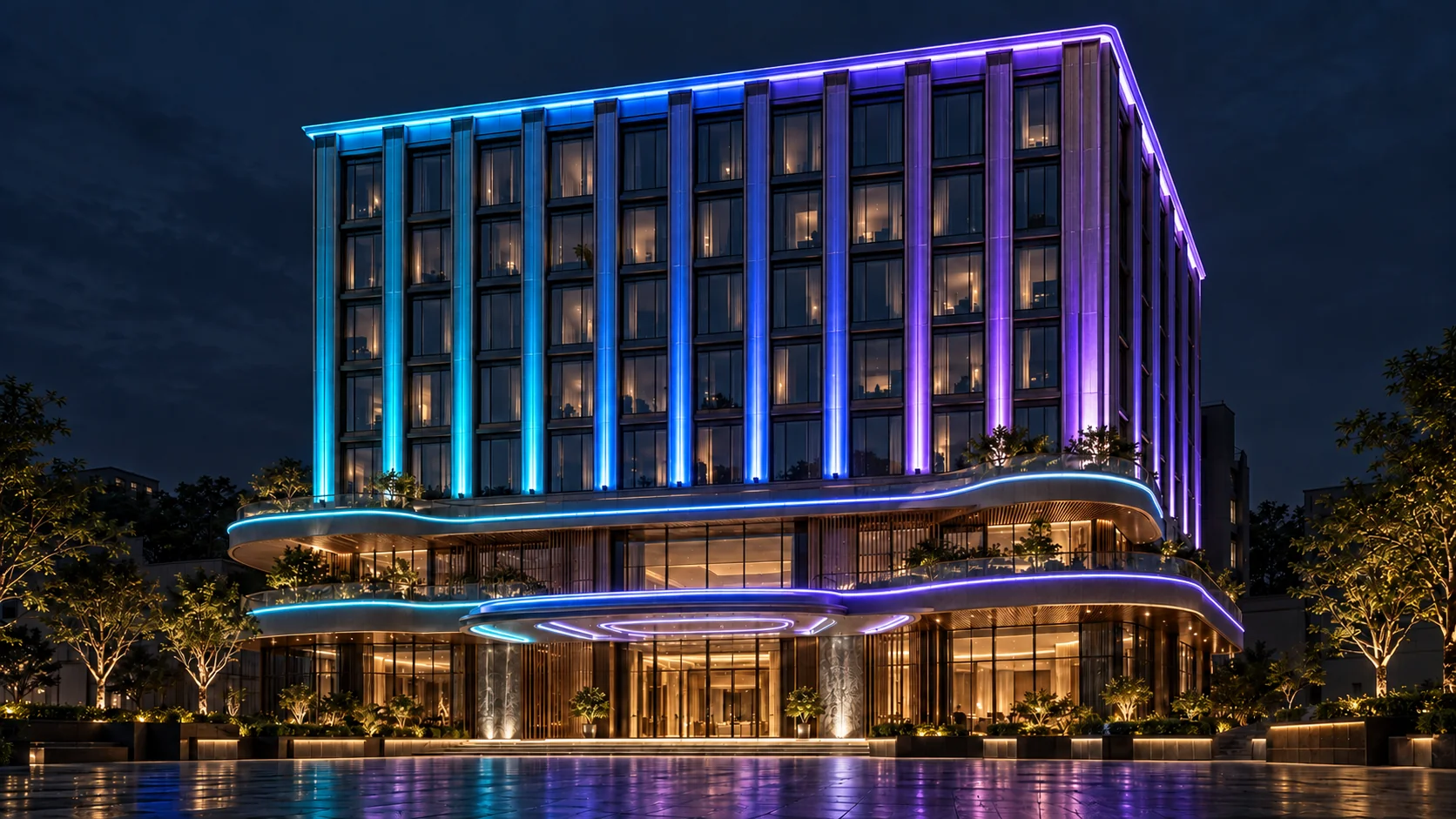
Facade lighting technology has changed a great deal in recent years. Three solutions are helping buildings run more reliably and at lower cost: 48 V LED, 4G-connected controllers and RDM fault monitoring. This article explains how ARTTEC combines them in two different situations: buildings under construction and buildings already in use.
Three solutions, three problems solved
| Solution | Problem solved | Main benefit |
|---|---|---|
| 48 V LED | Long lines dim towards the end, many drivers on the facade | Even light, fewer drivers, fewer failure points |
| 4G controller | Site visits needed to change scenes, hard to synchronise several buildings | Remote management, synchronisation without cables |
| RDM monitoring | No way to know which fixture failed, slow replacement | Self-reported faults, remote addressing |
New projects: optimise from the design stage
For a building under construction, this is the cheapest moment to get it right. ARTTEC recommends:
- Approve the look with a 3D simulation first, then select equipment to match the approved effects.
- Use 48 V LED for long contours, grouping drivers in a technical cabinet instead of spreading them across the facade.
- Choose RDM-capable fixtures and splitters so fault monitoring works from handover day.
- Reserve conduit routes, cabinet positions and antenna locations for the 4G controller, coordinated with the MEP design.
- Plan maintenance access along the building’s gondola route or plant floors.
Existing buildings: upgrade without starting over
For occupied buildings, the aim is maximum improvement with minimum intervention:
- Survey the existing installation: how much of the brackets, conduits, cables and panels can be reused.
- Replace fixtures with 48 V LED to make use of small existing conduits and reduce drivers on the facade.
- Install a 4G controller for schedules, scenes and remote management without new network cabling in the building.
- Add RDM when replacing fixtures and splitters, keeping the DMX cabling if it is still in good condition.
- Work in phases, starting with the main facade and logo, with a schedule agreed with building management to minimise disruption.
See also retrofitting old facade lighting.
Benefits for the owner
- Lower running costs: less energy lost and fewer maintenance trips at height.
- A consistently good image: faults are found and fixed early, so the facade never looks patchy.
- Flexibility: change scenes for events and holidays from a phone.
- Easy expansion: add buildings and areas to the same management system.
How ARTTEC works
Site survey, 3D simulation and sign-off, technical design with an itemised estimate, contract, then installation and handover. The person who surveys with you stays with the project until handover. See the indicative facade lighting budgets.
Frequently asked questions
Do all three solutions have to be used together?
No. Each can be used on its own. ARTTEC recommends the right combination for the scale and budget of each project.
Does an existing building have to close during the retrofit?
Usually not. Most work is done outside and split into phases on a schedule agreed with building management.
New project or existing building, send photos and drawings via Zalo +84 935 004 188 and ARTTEC will recommend a suitable setup.

One thought on “Next-Generation Facade Lighting for New and Existing Buildings”