


Towers with curved, shell-like balconies stacked in a staggered pattern and covered with plants are appearing in more and more new architectural proposals in Vietnam. By day, the building stands out with its white forms and greenery. At night, if only a few floodlights are aimed upwards, the curved forms and plants disappear into darkness. This article sets out the lighting concept ARTTEC proposes for this type of building, based on an architectural rendering of a tower of around 20 floors with an arched podium and a planted roof.
Read the architecture before placing lights
Good lighting design starts with understanding how the building wants to be seen. For this tower, four features should remain visible at night:
- The staggered balcony rhythm: each apartment is a curved shell projecting outwards, offset like a honeycomb. This is the building’s identity.
- Curved balcony soffits: the white curved undersides reflect light beautifully, like an upturned bowl.
- Plants along the balcony edges: planters along each balcony form green bands across the facade.
- The arched podium and crown: two podium floors with tall arches and a glazed entrance, and a planted roof terrace at the top.
The principle is not to flood the whole facade but to emphasise these features, so the building reads at night with the same form as by day.
Concept: green lanterns
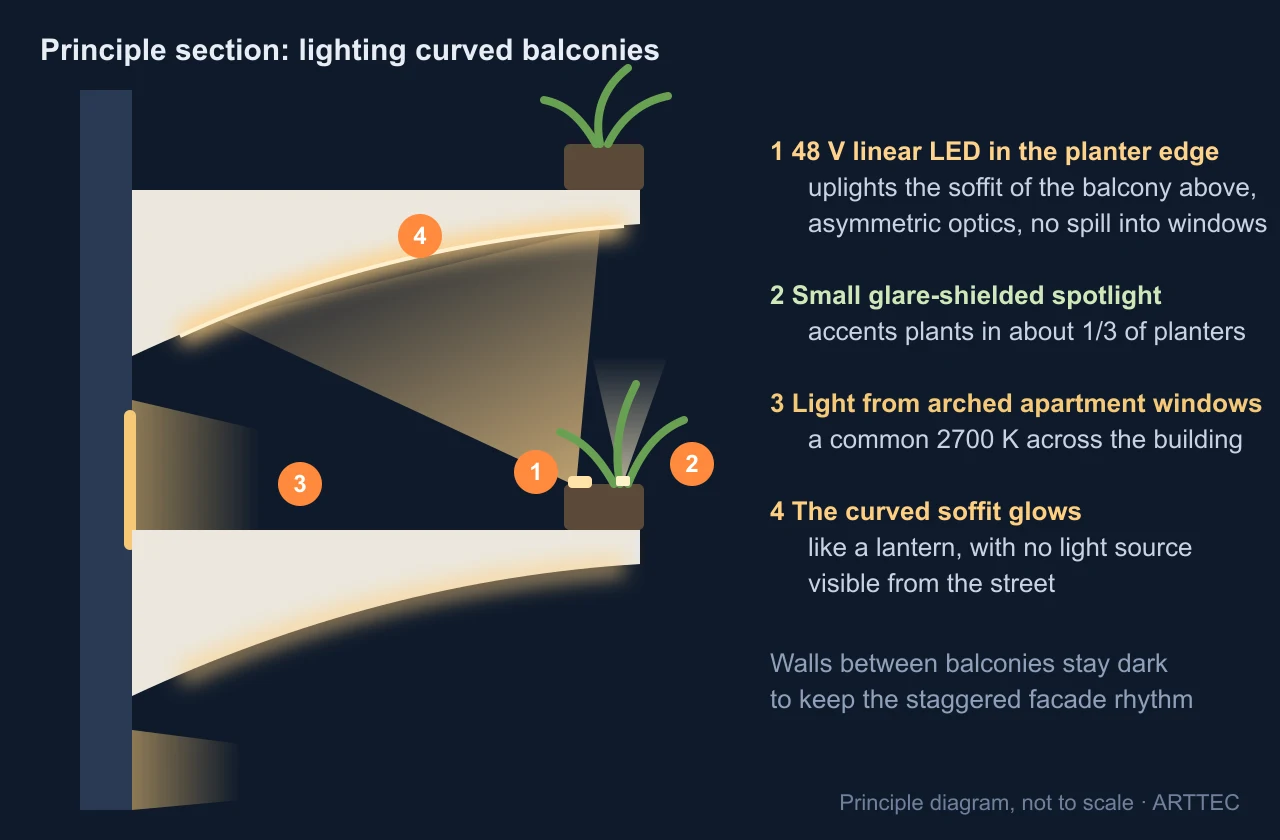
Each balcony is treated as a small lantern: the curved soffit glows warm, plants are lightly accented, and the wall between balconies stays dark. From a distance the facade appears as hundreds of staggered lanterns, keeping the architectural rhythm without glare for residents.
Five proposed lighting layers
1. Balcony soffit uplighting
This is the most important layer. Linear LED fixtures are concealed in the planter edge of the balcony below, aimed at the curved soffit of the balcony above. The white curved surface reflects soft light, creating a glowing bowl effect with no visible light source. Asymmetric optics spread light evenly over the curve without spilling into apartment windows.
2. Plant accents
Small spotlights with glare shields are placed in planters to light trunks and canopies. Not every planter needs one: lighting about one third in an alternating pattern looks more natural, costs less and reduces maintenance points. Planter fixtures must be IP68 with sealed conduit and junction boxes because they are watered regularly.
3. Arched podium
The podium arches are what pedestrians see closest. We propose narrow-beam in-ground fixtures grazing up the columns to the top of each arch, with soft light inside the arch. The glazed entrance is brighter than everywhere else to guide visitors. The trailing plants on the third floor are lit from above, forming a green outline that separates podium from tower.
4. Crown
The roof and top balconies are about 20 to 30 percent brighter than the tower body, with the roof terrace trees clearly lit. A bright crown gives the building a clear silhouette against the night sky and makes it recognisable from afar.
5. Light from apartments
Arched apartment windows are also a layer of light. The owner should specify a common colour temperature for balcony ceiling lights, for example 2700 K, so the facade is not patchy with different whites from different apartments.
Brightness hierarchy
| Position | Relative brightness | Colour temperature |
|---|---|---|
| Glazed entrance, podium | Highest (100%) | 3000 K |
| Crown, roof terrace trees | High (80–100%) | 3000 K |
| Balcony soffits on the tower body | Medium (40–60%) | 2700–3000 K |
| Plants in balcony planters | Low (20–40%) | 3000 K |
| Walls between balconies | Left dark | Not lit |
Static every night, dynamic for festivals
For residential buildings, nightly lighting should be static warm white to keep an elegant look. If the soffit fixtures are tunable white or RGBW and each balcony is individually controlled, the building gains scenes for special occasions:
- Breathing: light slowly brightens and softens from base to crown, each cycle lasting tens of seconds.
- Tet and festivals: red and gold spreading floor by floor.
- Owner events: brand colours for a short period.
Effects should change slowly and at moderate brightness so they do not disturb residents.
Power and control infrastructure
- Centralised 48 V supply: power supplies in technical risers every few floors reduce voltage drop on long runs and keep supplies off the balconies. See 48 V LED facade lighting.
- 4G control: sunset scheduling, dimming after midnight, scene changes from a phone. See 4G controllers.
- RDM fault monitoring: with hundreds of fixtures on high balconies, knowing exactly which fixture has failed reduces trips at height. See RDM fault monitoring.
Points to agree early with the architect
- Recesses in the planter edge: must be allowed for in the structural design, because cutting concrete afterwards is very difficult.
- Cable routes: sleeves from technical risers to each balcony, avoiding surface cables on the white facade.
- Maintenance access: planters sit on private balconies, so either agree access with residents or design for replacement from outside with suspended equipment.
- Waterproofing and roots: fixtures and junction boxes sit above the waterproofing layer with root barriers, never buried directly in soil.
- Glare into apartments: verify on the 3D model that no beam shines directly into windows.
ARTTEC’s proposed process
- Receive drawings or renderings, survey the site if the building already exists.
- Build a night-time 3D simulation of each lighting layer for the owner and architect to approve.
- Approve the 3D before detailed design, quantities and estimate.
- Sign the contract, install and aim each fixture on site. The surveyor stays with the project until handover.
Frequently asked questions
Does lighting heat or harm the plants?
Low-power LED fixtures produce very little heat. Keep fixtures away from trunks, use warm white light and switch off or dim after midnight so plants have a rest period.
Can the podium and crown be done first?
Yes. Many owners phase the work: podium and crown first, tower body later. In that case, cable sleeves and fixture recesses should be prepared in advance to avoid breaking out later.
Do you have a rendering or drawings of your project? Send them via Zalo +84 935 004 188 and ARTTEC will propose a lighting concept and a night-time 3D simulation for your building.
